1798
Political Economy · Population Theory

Thomas
Malthus

An exploration of the man who predicted humanity's doom, and why he was both profoundly influential and ultimately wrong.

Scroll to explore
01 / Who Was He?

The First Professor of
Political Economy

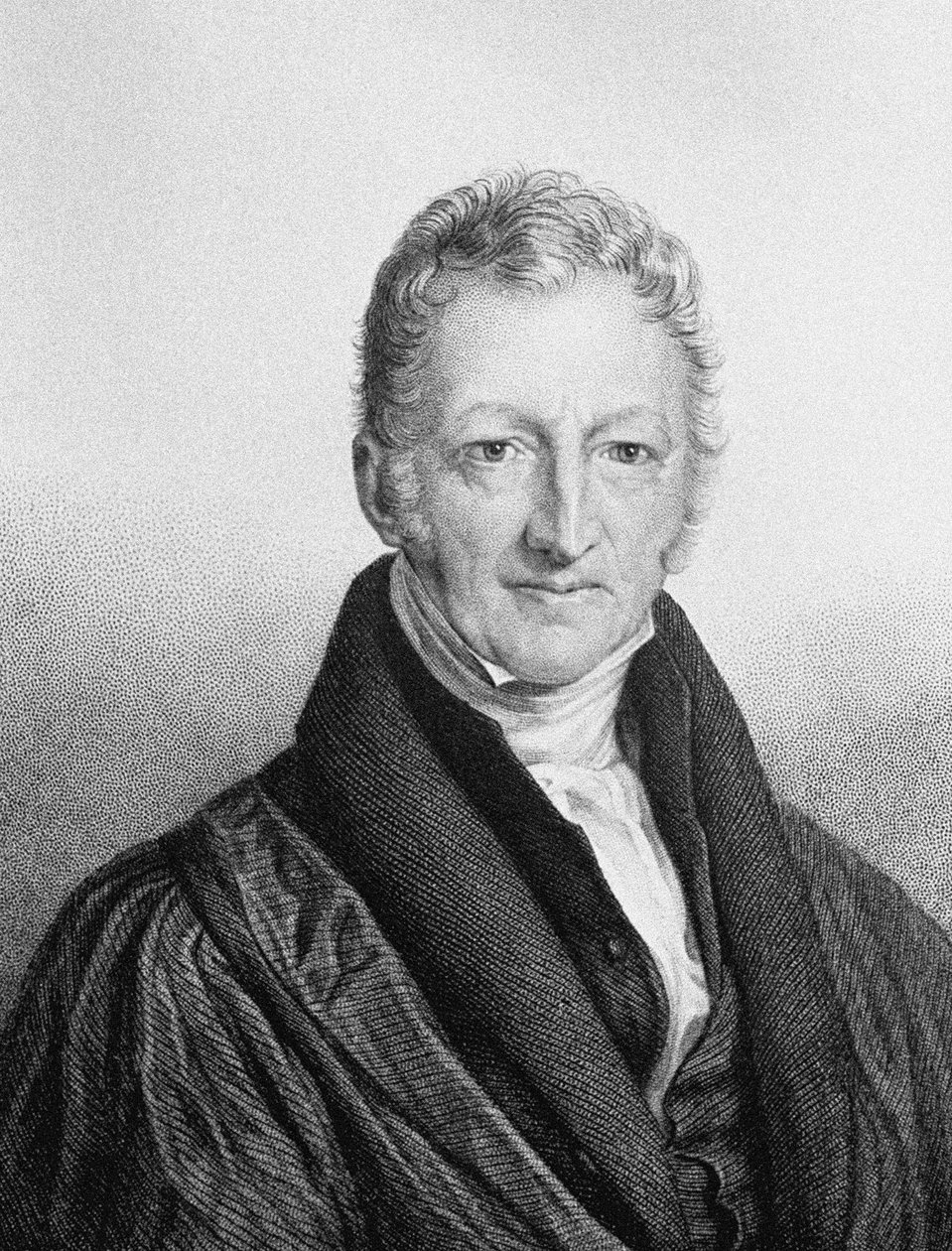
Portrait of Thomas Robert Malthus by John Linnell
Portrait by John Linnell, c. 1833
Born
1766
Nationality
English
Occupation
Church Leader & Economist
Famous Work
An Essay on the
Principle of Population
Published
1798
Core Claim
Some people must inevitably suffer from hunger and poverty
02 / The Theory

Population vs.
Food Production

Population Growth (×2 each period)
Food Production (+1 each period)
"Population, when unchecked, increases in a geometrical ratio. Subsistence increases only in an arithmetical ratio."
Thomas Malthus, 1798
Malthus believed natural disasters, diseases, and famines were nature's way of correcting overpopulation. He also argued that people should marry late and delay having children. Crucially, he did not use the scientific method; he treated his formula as self-evident, inspired by history and older philosophers like Plato.
03 / Evidence and Reception

How His Theory
Was Received

Malthus supported his theory through several types of historical evidence. He pointed to mass migrations throughout history that were caused by overpopulation, with entire peoples forced to move when their land could no longer feed them.

He also observed the division and sub-division of farms in Central Europe, where plots grew smaller with each generation as parents split land among their children. Closer to home, his own parents had seven children, a vivid personal example of the population pressure he was describing.

Charles Darwin
Inspired
Used Malthus's ideas about population pressure and limited resources as a key inspiration for his theory of natural selection and evolution.
Karl Marx
Opposed
Alongside Engels, Marx criticised Malthus for lacking scientific proof and for using his theory to justify the suffering of the working class.
David Ricardo
Sceptical
The famous economist questioned the scientific basis of Malthus's mathematical relationships between population and food supply.
Charles Dickens
Satirised
The novelist was said to have based the miserly Ebenezer Scrooge (A Christmas Carol) partly on Malthus's cold, strict views about the poor.

The real-world consequences of Malthusian thinking were severe. During the Irish Famine of the 1840s, the British government provided minimal aid, a decision heavily influenced by the belief that mass starvation was a natural, even necessary, correction of overpopulation.

This led to catastrophic mass starvation and triggered one of the largest waves of emigration in Irish history, with millions forced to leave for America. Malthus's theories provided an intellectual justification for political inaction in the face of humanitarian disaster.

At the start to mid-19th century, England experienced extremely high birth rates while death rates dropped sharply, the result of of improved medicine and cleaner living conditions. This created a massive population boom that seemed to confirm Malthus's fears.

Europe's broader response to resource scarcity was colonial expansion: shipping large numbers of people to the Americas and other overseas territories. The full title of Malthus's work reflects his concern: "An Essay on the Principle of Population, as it affects the future improvement of society."
04 / Key Events

A Theory's Legacy
Through Time

1766
Thomas Malthus is Born
Born in England, Malthus would grow up to become the world's first professor of political economy and an Anglican clergyman.
1798
Essay on Population Published
His landmark work argues population grows geometrically while food supplies grow arithmetically, making poverty and famine inevitable.
1840s
The Irish Famine
The British government's Malthus-influenced refusal to provide adequate relief leads to mass starvation and the emigration of millions to America.
1840s
Darwin's Theory of Evolution
Charles Darwin credits Malthus's ideas about population pressure as a key inspiration for his theory of natural selection.
1800s
Justus von Liebig's Discovery
The invention of artificial fertilizer begins to shatter the assumption that food production cannot keep pace with population growth.
1960s–70s
The Green Revolution
New high-yield seeds, pesticides, and mechanisation transform global agriculture. Food production vastly outpaces even Malthus's worst predictions.
20th Century
Neo-Malthusianism
Environmentalists revive Malthus's warnings about overpopulation and resource depletion, but they again fail to anticipate technological solutions.
Early 2000s
GMO Protests
Demonstrations erupt worldwide against large agricultural corporations and the spread of genetically modified crops controlling the food supply.
2015
UN Halves World Hunger
The United Nations achieves its Millennium Development Goal of cutting extreme hunger in half, even as the world population surpasses 7 billion.
2022
8 Billion People
The world's population reaches 8 billion, yet global extreme poverty rates have fallen dramatically from Malthus's era, the opposite of his predictions.
05 / By the Numbers

Malthus in Numbers

0
Year Malthus was born
0billion
World population today
0
Children in Malthus's own family
0
Year Essay on Population published
06 / Discussion

Was Malthus
Right or Wrong?

In 2026, Thomas Malthus's main idea is mostly wrong on a global level. His prediction that population growth would always outpace food production, leading to mass starvation, has not come to pass, thanks largely to human ingenuity.

The Green Revolution of the 20th century, with its new seeds, chemical fertilisers, and advanced machinery, allowed food production to keep pace with a world population that has now surpassed 8 billion people.

The United Nations achieved its goal of cutting world hunger in half by 2015, even as the global population continued to grow. Birth rates have also fallen dramatically in most countries due to better education and access to contraception. Global extreme poverty has actually declined since Malthus's era, the opposite of what he predicted.

Malthus fundamentally did not believe enough in human creativity. His dark view that poverty is a natural, unavoidable law is too pessimistic. However, his warnings are not entirely useless. In some regions, particularly parts of Africa, rapid population growth still places heavy pressure on local resources. Modern concerns about climate change and environmental degradation echo his fundamental insight that Earth has limits.

We avoided a global Malthusian catastrophe through technology. But his thesis remains a useful reminder: we must continue to farm in smart, sustainable ways to ensure food security in 2026 and beyond.

07 / Test Yourself

Quick Knowledge
Check

08 / Sources